Introduction
Before you can operate Amateur Radio Transmitting Equipment you must obtain an Amateur Radio Transmitting Licence. The present system of Amateur Radio Licensing is intended to provide an inclusive, incentive based progression through levels of knowledge obtained practically through the use of radio.
The current levels of Amateur Radio Licence are:
- Foundation,
- Intermediate, and
- Full
You must either sit each of the tiered exams (Foundation, Intermediate, Full) or use the Driect to Full route that has now been made available alongside the staged approach which is (in the words of the RSGB) specifically aimed at aspiring amateurs who are already competent in related technical subjects. However, it is open to all, and Foundation and Intermediate amateurs are free to enroll for the Direct to Full examination or continue along the three-tier route as they wish.
The following sections describe very briefly and in general terms the privileges granted at each level of licence and the course content. The full Syllabi for the courses can be accessed via the RSGB website.
What To Do Next
If you are interested in one of the courses that we have indicated is available below, please contact the training team by email. One of the Training Team will usually respond within a couple of days unless we have to coordinate amongst ourselves in which case it might take up to a week to compose a response.
| Course Type | Instructor(s) | Start Date and Details | Anticipated Exam Date |
|---|---|---|---|
| Foundation Tier 1 of 3 |
Andy G7KNA | We plan to hold an on-line course, for further details please see this news post. | Between 19/08/2024 and 31/08/2024 to avoid the Licensing Conditions update due on 01/09/2024. |
| Intermediate Tier 2 of 3 |
We currently have no plans to hold an Intermediate Course at this time. | ||
| Full Tier 3 of 3 |
Our Full training programme has not been updated to the latest syllabus and the work involved with our currently reduced Training Team is too great to make the effort expended to update this section worthwhile. We have no plans to run any further Full Licence Courses. We can recommend the Bath Based Distance Learning (BBDL) courses. | ||
| Direct to Full | We have no plans to introduce specific training notes or presentations for this syllabus and no plans to provide any Direct to Full courses. |
If our training programme doesn’t fit with your personal timetable or availability, there are a range of on-line courses available from a variety of providers. The RSGB maintain a list of these on-line resources on their website where you can find links to on-line teaching.
“Official” textbooks are available from the RSGB and Amazon amongst other places:
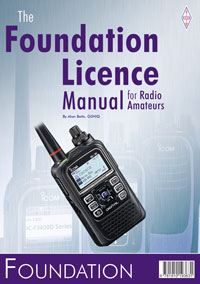
- Foundation Licence Manual Kindle Version
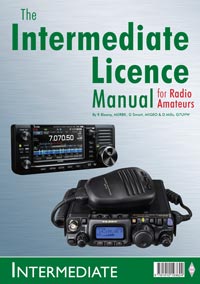
- Intermediate Licence Manual Kindle Version
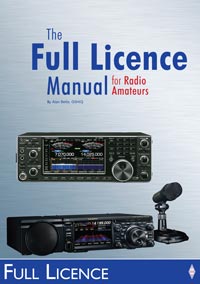
- Full Licence Manual Kindle Version
Students are now able to book their exam on-line on the RSGB website.
Information to assist with the exam process and the practicalities of an on-line exam can be found at:
- RSGB Information for Students including links to exam information etc.
- RSGB Resources for Students
- Exam FAQs
- Exam Forms
- Candidate Instructions for Remotely Invigilated Exams
- Remotely Invigilated Exam FAQs
Foundation Licence
In simplistic terms this is the “entry level” licence, it is currently the minimum you require to transmit legally on the Amateur Radio bands. The course represents an introduction to radio operation and radio theory and can be completed by anyone with an interest in radio and a desire to learn. There is no requirement to have any prior understanding or use of radio.
The course content is covered in about 10 sessions each lasting around 45 minutes – 1 hour and introduces you very gently to:
- Content and structure of the licence,
- Rules and regulations governing use of the Amateur Radio spectrum,
- Basic electrical theory: application of Ohms Law (V=IxR and P=IxV) to simple circuits,
- Simple propagation theory – how radio waves travel, why some bands are worldwide and others are 10 miles in range, and
- An introduction to antennas and feeders (the wire from your transceiver to the antenna).
In addition to the theoretical work there are also a number of simple practical exercises (which are suspended during the Coronavirus pandemic) designed to introduce you to the use of Amateur Radio, the types of contacts you may have and some of the operating practices and procedures to ensure that you are comfortable with operating equipment once you obtain your licence.
Once you have obtained your Foundation Licence you will be able to do the following:
- Transmit legally on the following Amateur Radio Bands: 2200m, all bands from 160m – 70cm (excluding 60m) and the 13cm, 6cm and 3cm bands from the United Kingdom,
- Use amateur radio transmitting equipment with a maximum output of 25W (some bands have additional restrictions),
- Use FM, AM, SSB, CW and data modes in any of the above Amateur Radio Bands as set out in the UK Band Plans,
- Operate via Amateur Radio Satellites,
- Contact other licensed amateurs throughout the world or just around the corner, and
- Take part in Amateur Radio competitions and contests.
Some limitations are imposed on the operation of the Foundation licence, a few are set out below:
- Maximum power of 25W out of the transceiver (some bands have additional restrictions),
- May not operate in countries outside of the UK without an appropriate licence from the local authorities. The Foundation Licence will not automatically qualify you for a foreign licence in any country outside of the UK.
Intermediate Licence
The next step on the ladder, the Intermediate Licence takes you deeper into the theory of radio and electronics and confers additional bands, power and other privileges compared to the Foundation Licence. In order to sit the Intermediate Exam you must have passed the Foundation Exam.
The Intermediate Course builds on the Foundation and the practical experience you will have gained as a Foundation operator. The course is longer, taking around 30 sessions compared to the 10 sessions required to complete the Foundation and goes deeper into the theories of:
- A deeper understanding of the Licence Conditions,
- Electronics – introduction of additional components, tuned circuits, AC,
- Transmitters and receivers – expanded block diagrams for different types of modulation, and
- Propagation – increased description of the Ionosphere.
As a result of passing the Intermediate Exam you will gain the following privileges over and above the Foundation Licence:
- Access to the following Amateur Bands: 2200m, 160m – 1.2mm (excluding 60m) from within the United Kingdom,
- Maximum output power of 100W on all allocated Amateur Bands (some bands have additional restrictions),
There are still restrictions imposed upon you an Intermediate Licence holder, some of the main ones are:
- Limit of 100W maximum power from the transceiver (some bands have additional restrictions), and
- May not operate in countries outside of the UK without an appropriate licence from the local authorities. The Intermediate Licence will not automatically qualify you for a foreign licence in any country outside of the UK.
Full Licence
The Advanced Exam is the final step on the incentive based licensing system and naturally provides the highest level of privileges and requires the highest level of knowledge. There are no practical exercises involved in the Advanced Exam, the additional knowledge is all related to theory of radio or electronics.
Once you have passed this exam you will have the following additional privileges over and above the Intermediate Licence:
- Access to all Amateur Radio bands from 2200m – 1.2mm,
- Limit of 1000W maximum power on primary bands (400W on secondary bands, and some bands have additional restrictions),
- Ability to operate “Maritime Mobile” in International Waters with the permission of the vessels master,
- Ability to apply for a “Notice of Variation” (NoV) to alter licence conditions for experimental purposes or to operate Special Event Stations,
- Reciprocal Licensing Agreements with many other countries allowing operation from foreign countries.
Direct to Full
Enrolments for the Direct to Full examinations opened in January 2023, six months after the publication of the new syllabus.
The examination is specifically aimed at aspiring amateurs who are already competent in related technical subjects. However, it will be open to all, and Foundation and Intermediate amateurs are free to enroll for the Direct to Full examination or continue along the three-tier route as they wish. No credit transfer between the two routes will be possible.
For further information on this route please refer to the RSGB website.